Difference between revisions of "News/2025"
Jump to navigation
Jump to search
(Started 2025 page with copied news from 2024.) |
|||
| Line 4: | Line 4: | ||
__NOTOC__ | __NOTOC__ | ||
{{h3|February}} | {{h3|February}} | ||
| − | [[File: | + | [[File:2025-SPIE-Rivas-Poster-Award.jpg|thumb|250px|link=https://iacl.ece.jhu.edu/images/thumb/6/60/2025-SPIE-Rivas-Poster-Award.jpg/2025-SPIE-Rivas-Poster-Award.jpg|Carlos Rivas' award for best poster titled '''"Unique MS lesion identification from MRI"''' at the {{iacl-pub spie2025}}]] |
| − | * Congratulations to | + | * Congratulations to Carlos Rivas on winning a Best Paper Award at the {{iacl-pub spie2025}} |
| − | * IACL papers at the {{iacl-pub | + | * IACL papers at the {{iacl-pub spie2025}} |
| − | ** | + | ** Carlos Rivas presented '''"Unique MS lesion identification from MRI"'''. |
** [[Savannah|Savannah P. Hays]] presented '''"Revisiting registration-based synthesis: A focus on unsupervised MR image synthesis"'''. | ** [[Savannah|Savannah P. Hays]] presented '''"Revisiting registration-based synthesis: A focus on unsupervised MR image synthesis"'''. | ||
** [https://sremedios.github.io/ Samuel Remedios] presented '''"Pushing the limits of zero-shot self-supervised super-resolution of anisotropic MR Images"''' and '''"Harmonization-enriched domain adaptation with light fine-tuning for multiple sclerosis lesion segmentation"'''. | ** [https://sremedios.github.io/ Samuel Remedios] presented '''"Pushing the limits of zero-shot self-supervised super-resolution of anisotropic MR Images"''' and '''"Harmonization-enriched domain adaptation with light fine-tuning for multiple sclerosis lesion segmentation"'''. | ||
Revision as of 20:56, 20 February 2025
2025
February

- Congratulations to Carlos Rivas on winning a Best Paper Award at the Proceedings of SPIE Medical Imaging (SPIE-MI 2025), San Diego, CA, February 16–20, 2025.
- IACL papers at the Proceedings of SPIE Medical Imaging (SPIE-MI 2025), San Diego, CA, February 16–20, 2025.
- Carlos Rivas presented "Unique MS lesion identification from MRI".
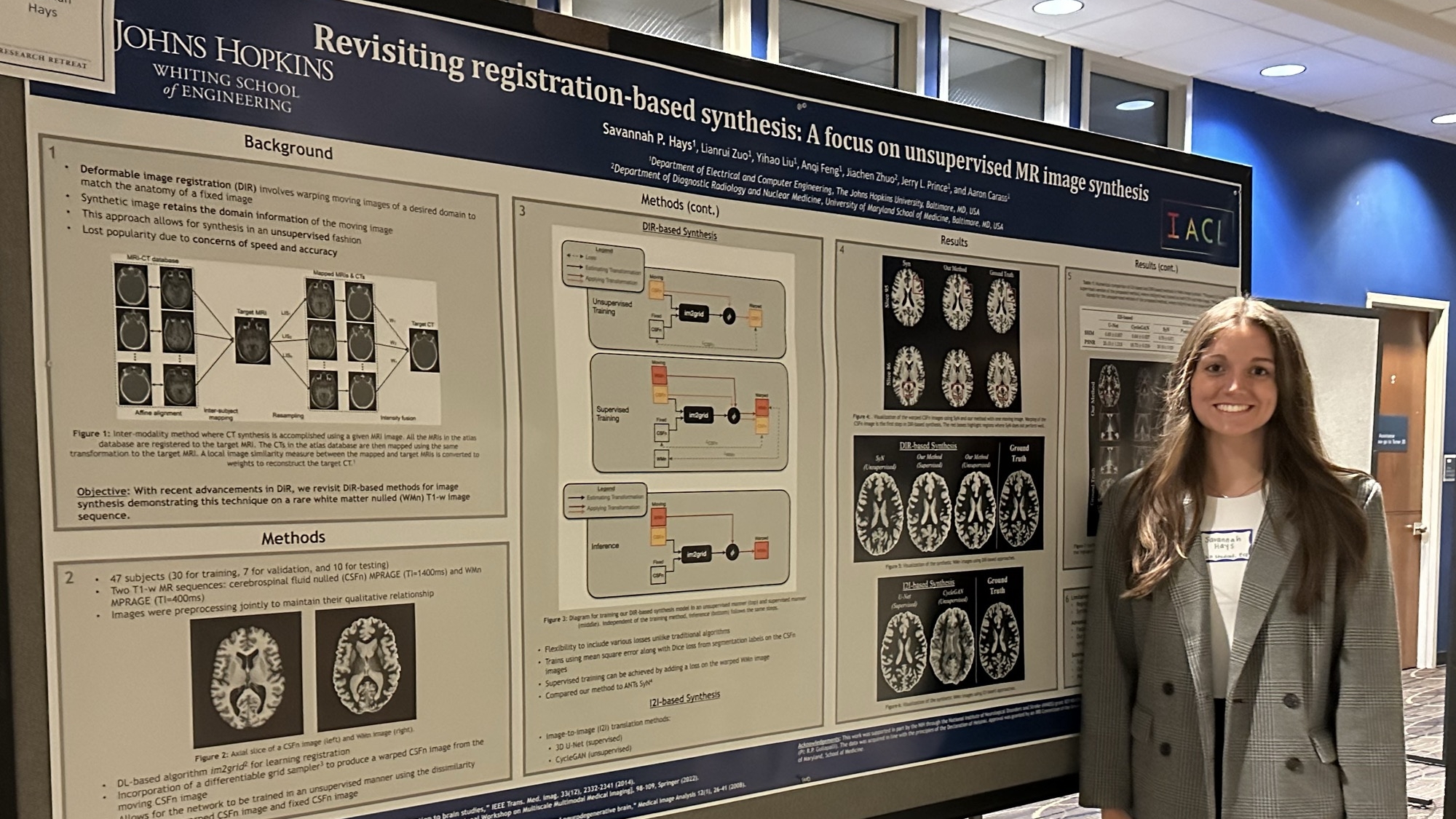
- Savannah P. Hays presented "Revisiting registration-based synthesis: A focus on unsupervised MR image synthesis".
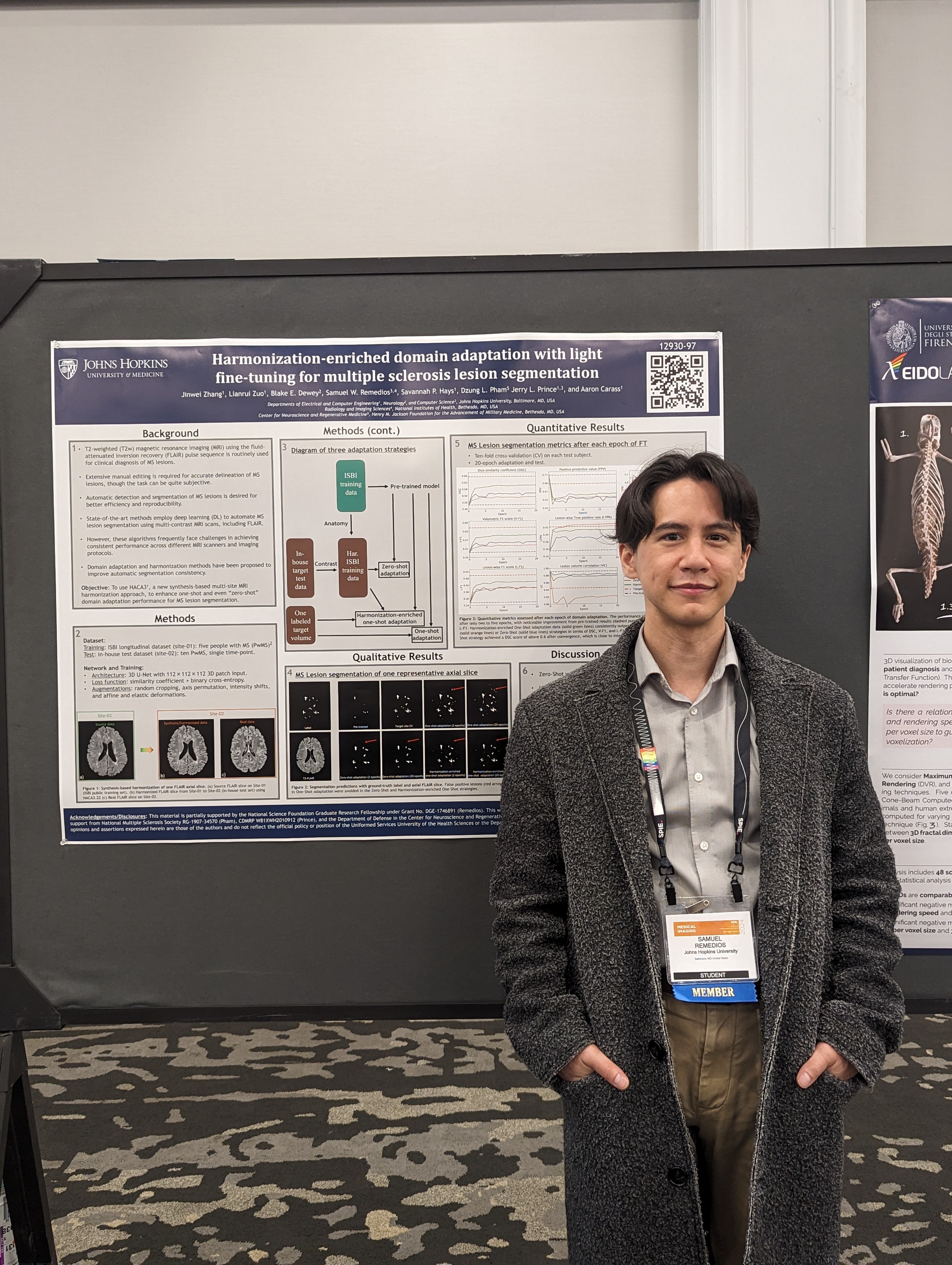
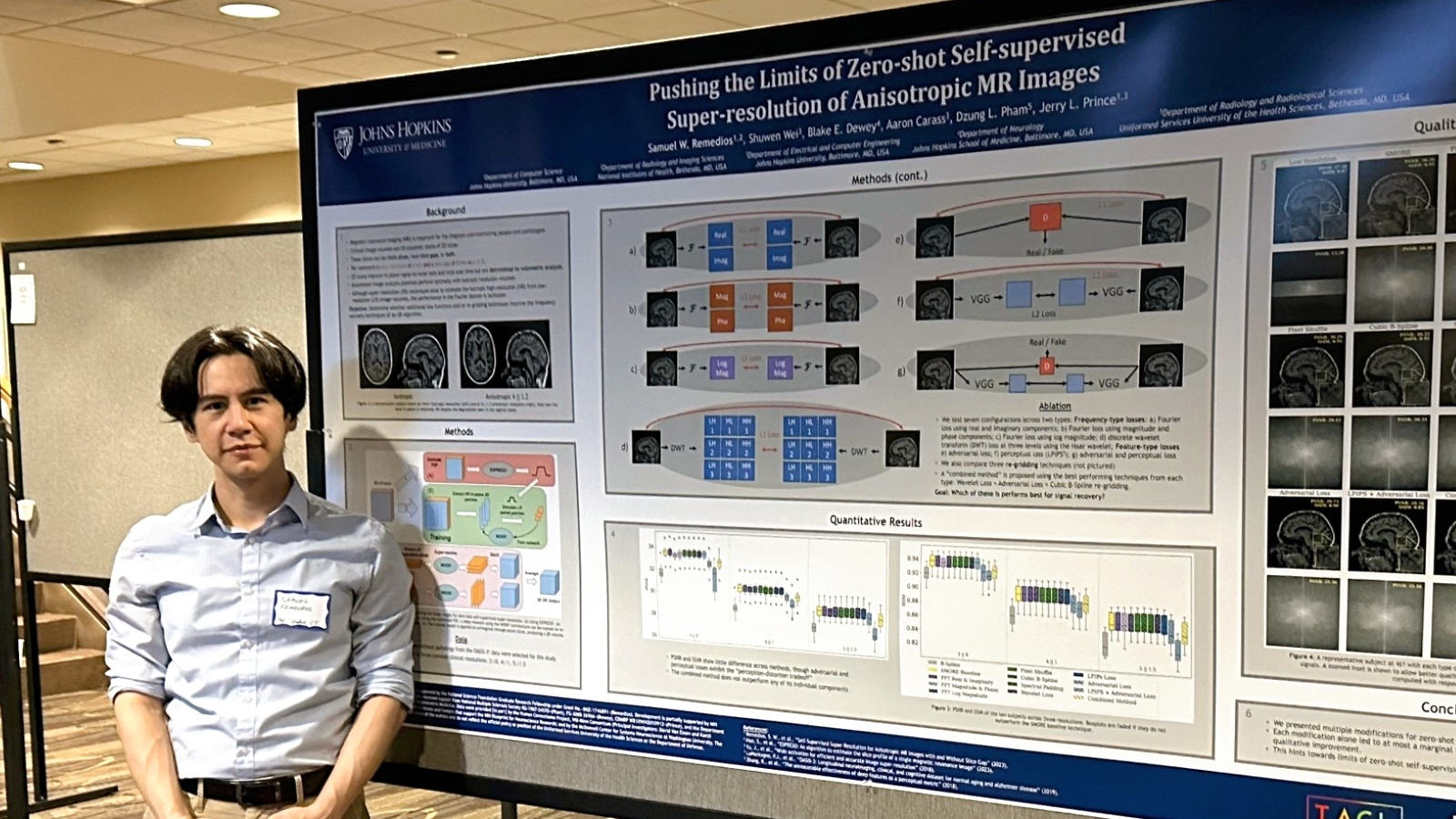
- Samuel Remedios presented "Pushing the limits of zero-shot self-supervised super-resolution of anisotropic MR Images" and "Harmonization-enriched domain adaptation with light fine-tuning for multiple sclerosis lesion segmentation".
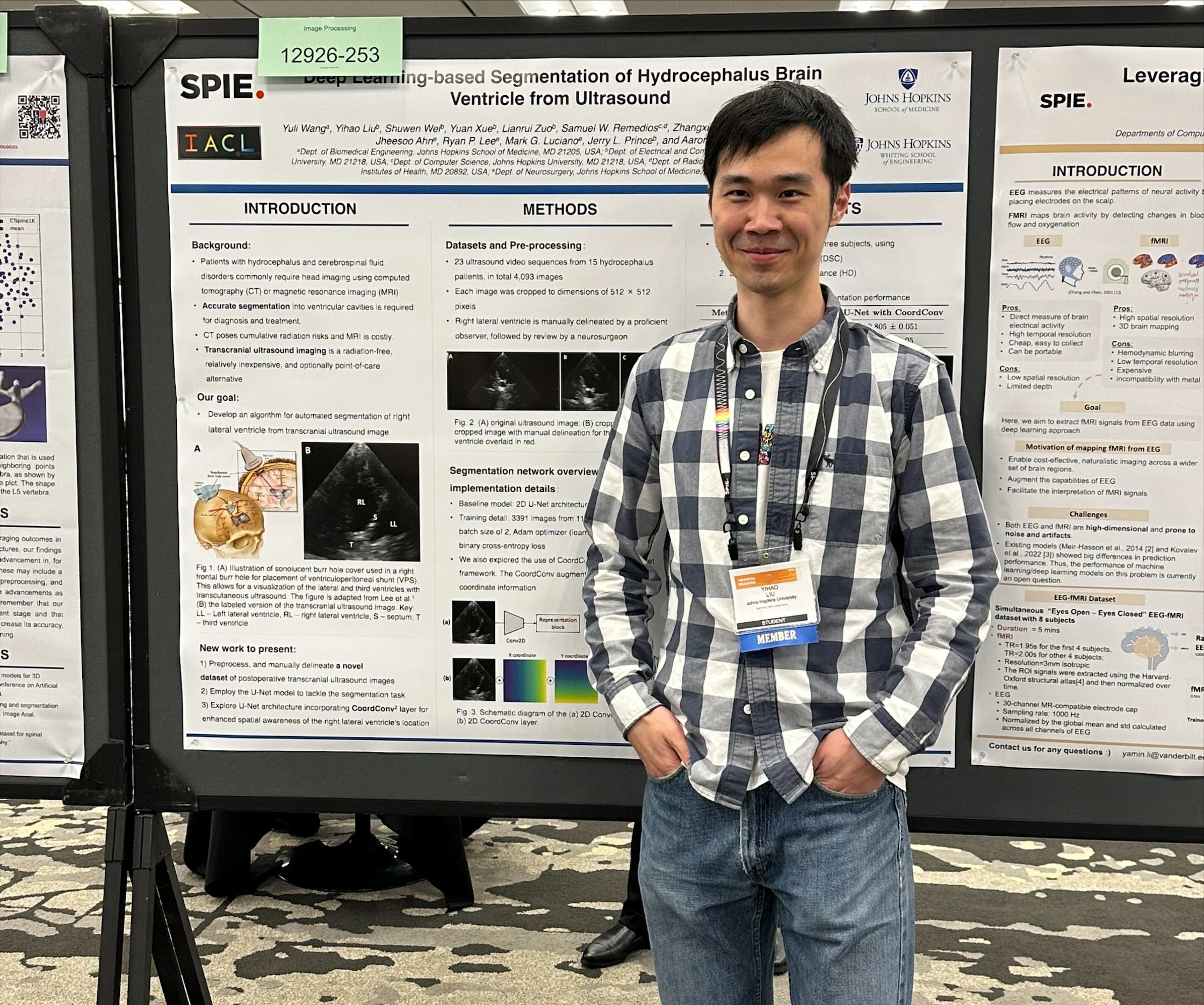
- Dr. Yihao Liu presented "Deep learning-based segmentation of hydrocephalus brain ventricle from ultrasound".
- Zejun Wu presented "AniRes2D: Anisotropic residual-enhanced diffusion for 2D MR super-resolution".
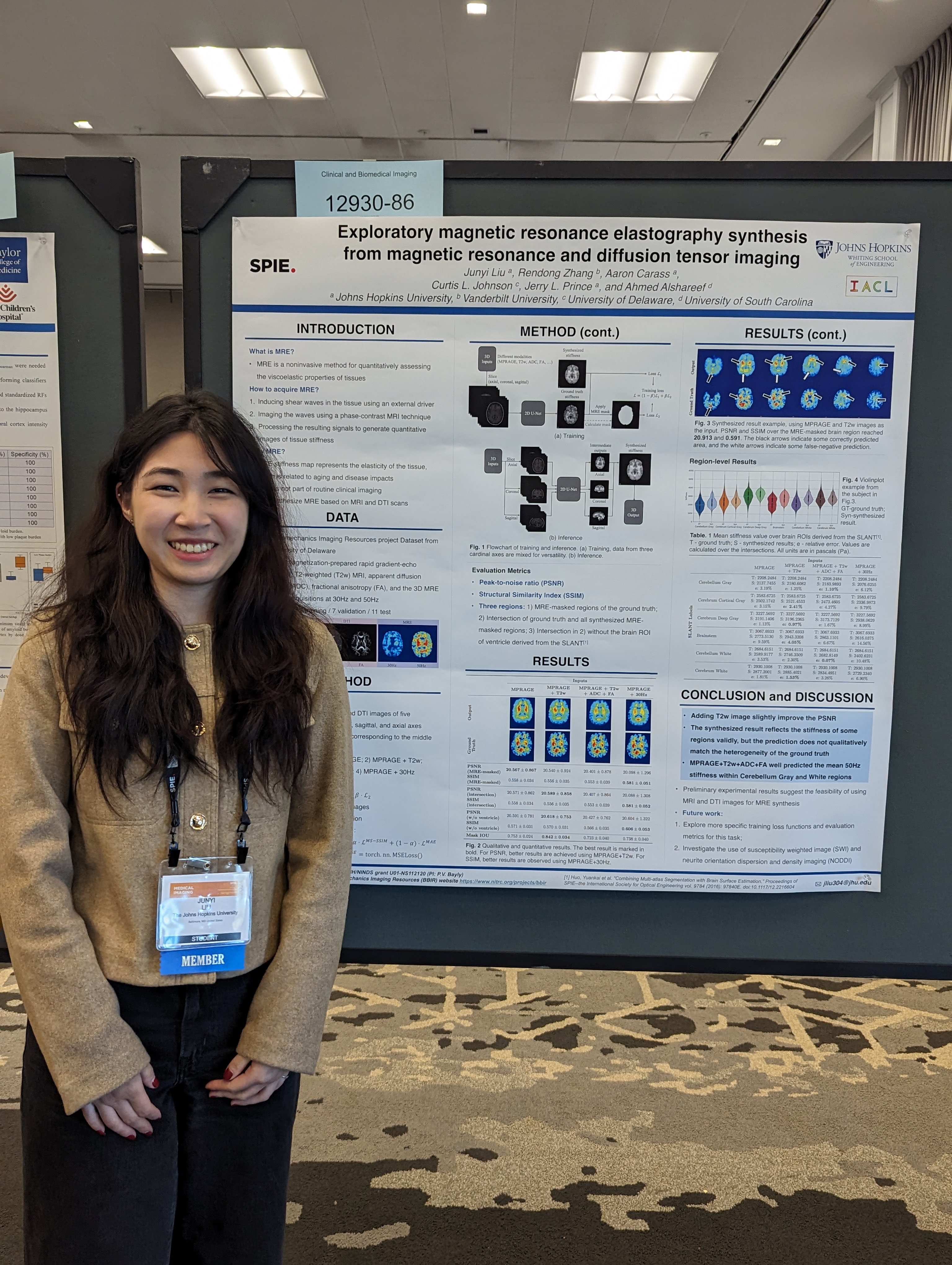
- Junyi Liu "Exploratory magnetic resonance elastography synthesis from magnetic resonance and diffusion tensor imaging".
- Other accepted papers at SPIE-MI 2024 coming from collaborations with IACL.
- Xiaofeng Liu from Massachusetts General Hospital, presented "Speech motion anomaly detection via cross-modal translation of 4D motion fields from tagged MRI".
| IACL at SPIE-MI 2024 | ||||
|
| |||
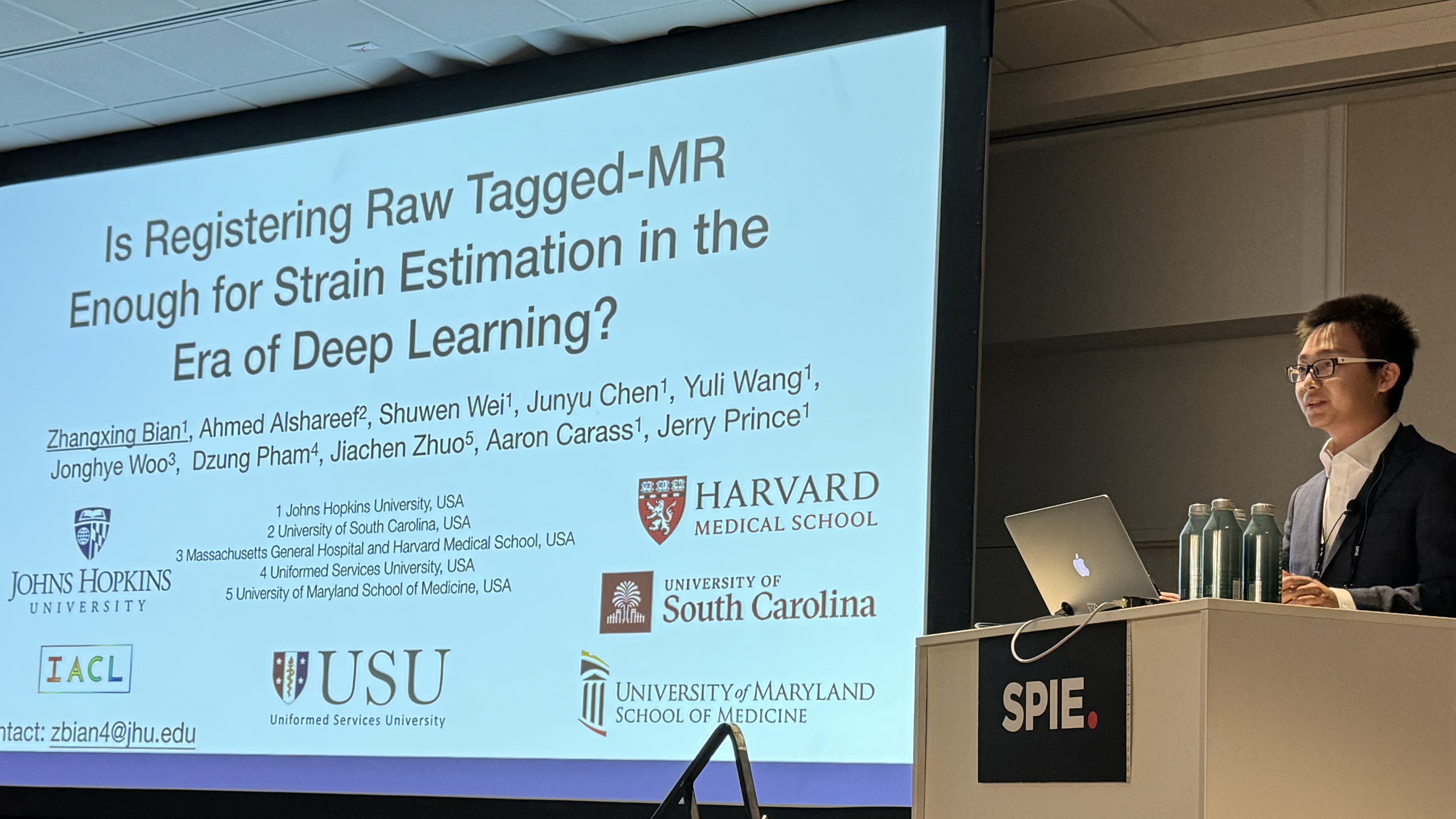
| Dr. Yihao Liu presenting Yuli Wang's work titled "Deep learning-based segmentation of hydrocephalus brain ventricle from ultrasound". | Zhangxing Bian presenting "Is Registering Raw Tagged-MR Enough for Strain Estimation in the Era of Deep Learning?". | |||
|
| |||
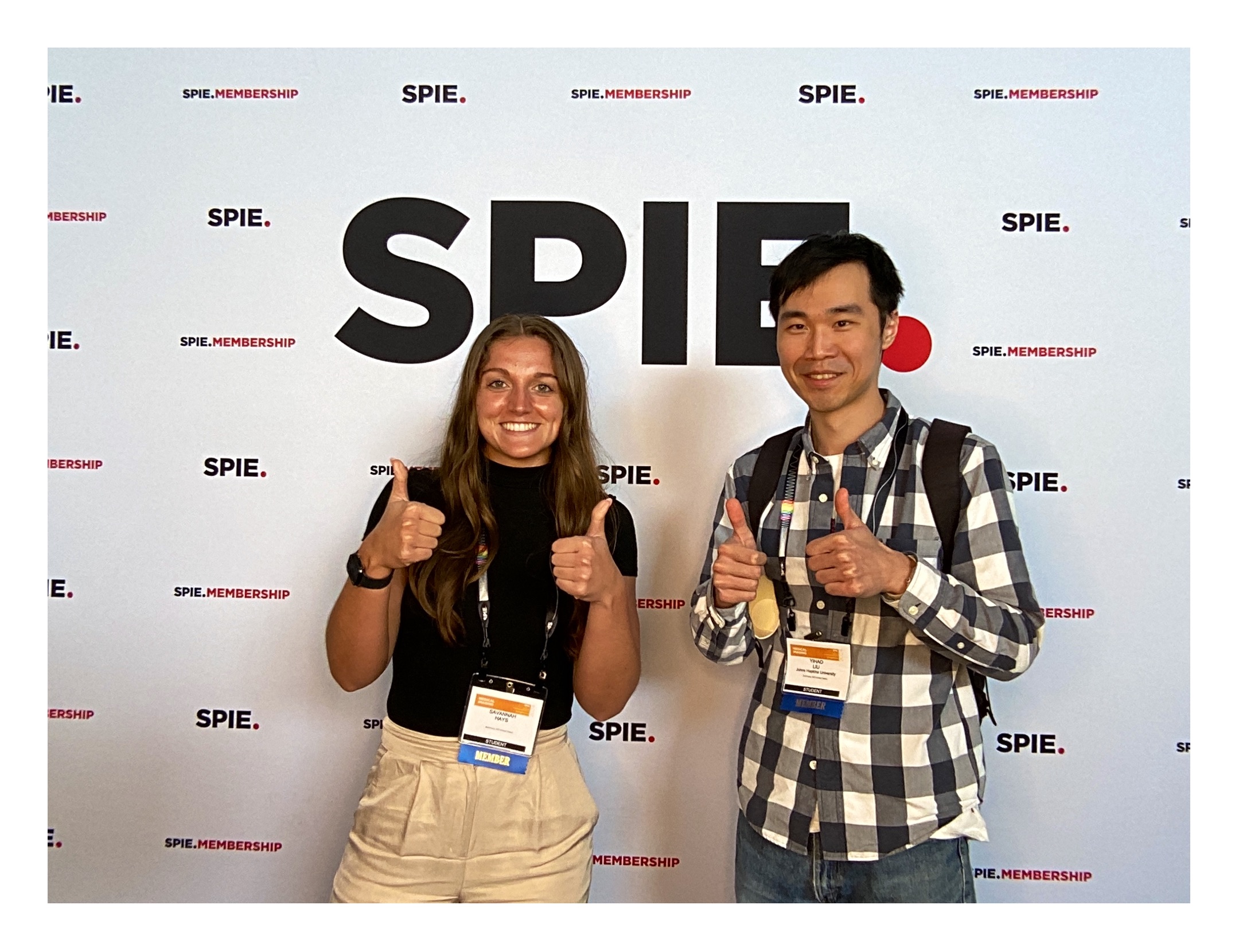
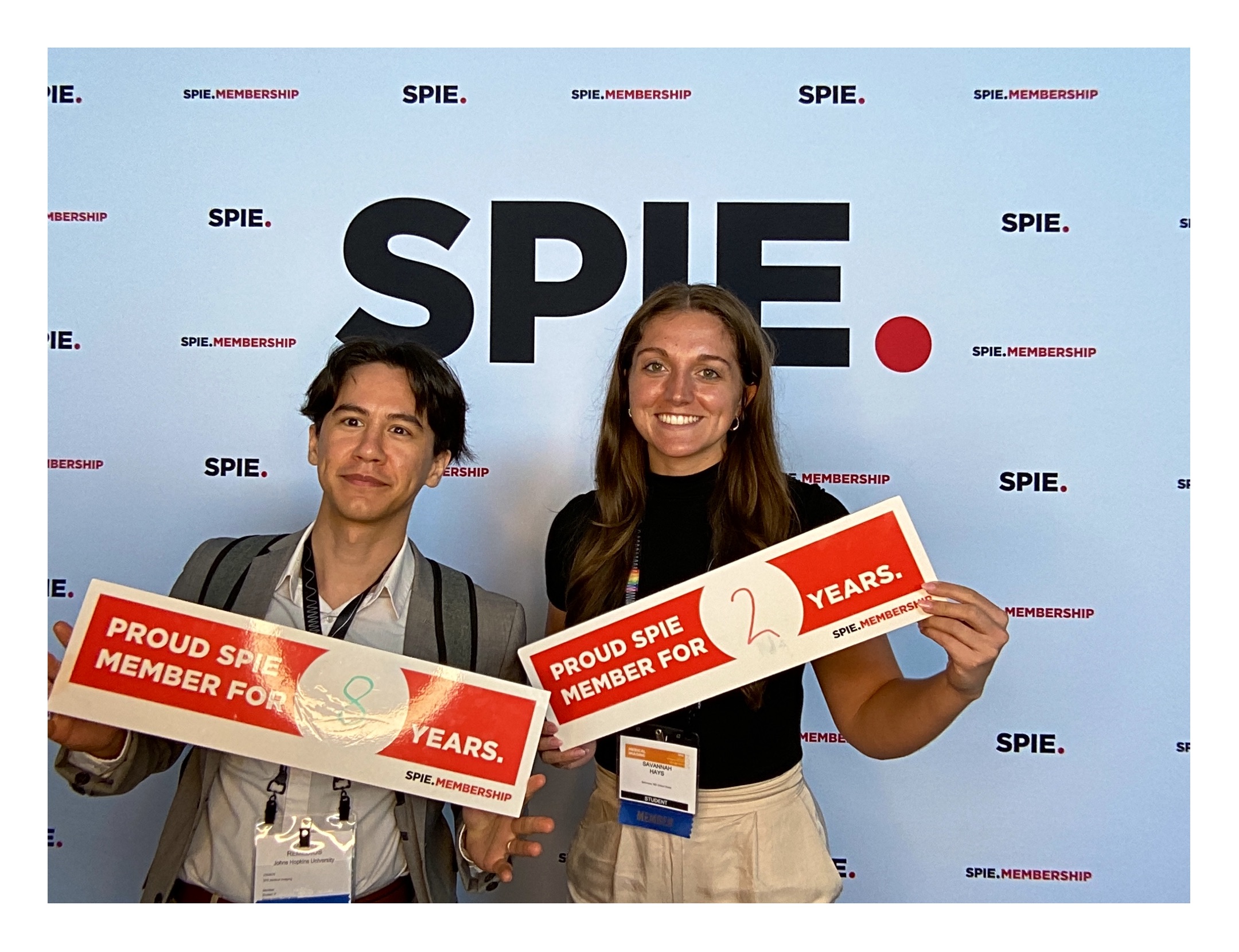
| Savannah P. Hays and Dr. Yihao Liu saying "Ayyy". | Samuel W. Remedios and Savannah P. Hays showing some SPIE pride. | |||
|
| |||
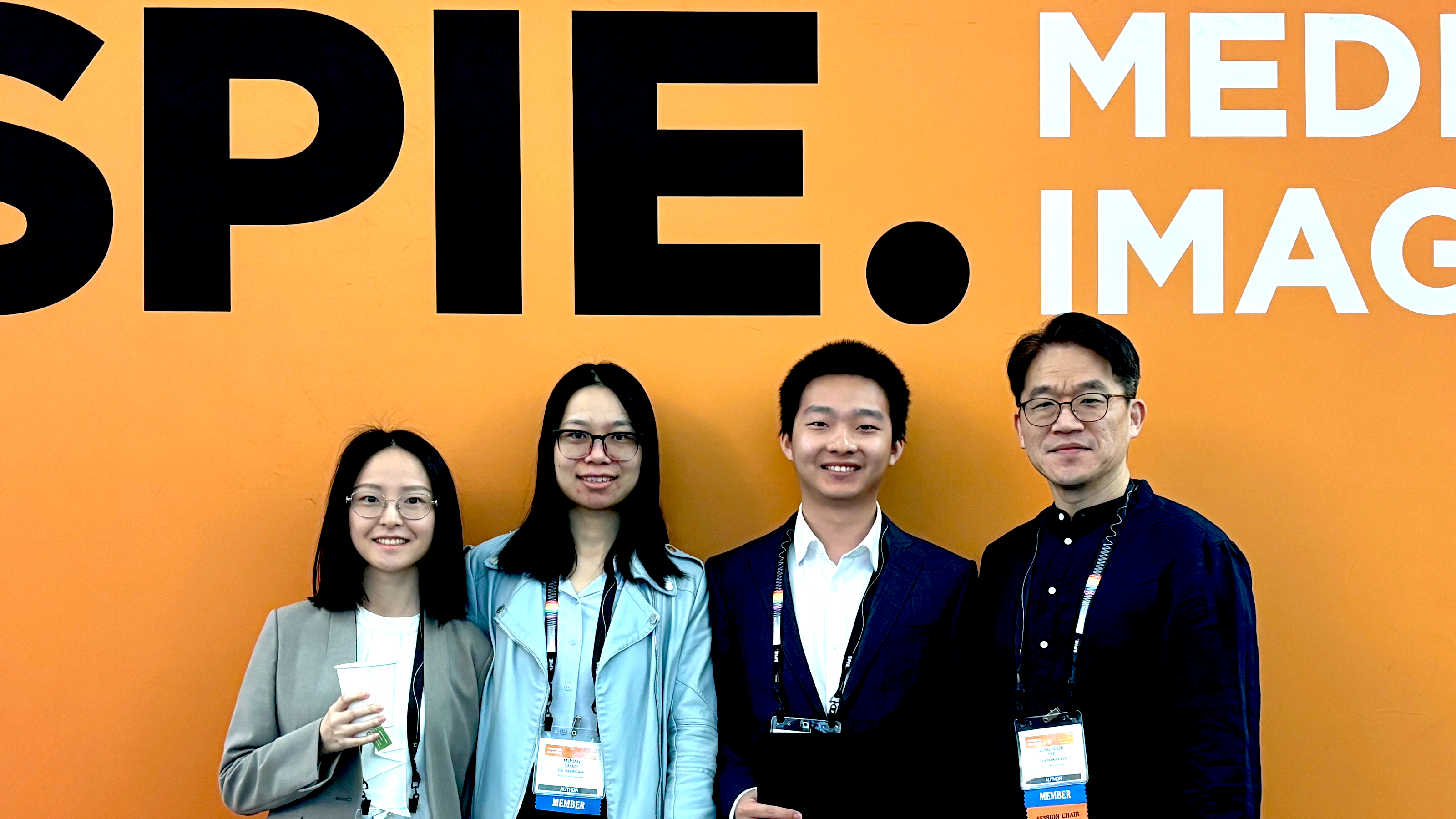
| IACL Lab members (new and old) at SPIE-MI 2024. | Samuel W. Remedios presenting "Harmonization-enriched domain adaptation with light fine-tuning for multiple sclerosis lesion segmentation". | |||
|
||||
| Junyi Liu presenting her poster titled "Exploratory magnetic resonance elastography synthesis from magnetic resonance and diffusion tensor imaging". | ||||
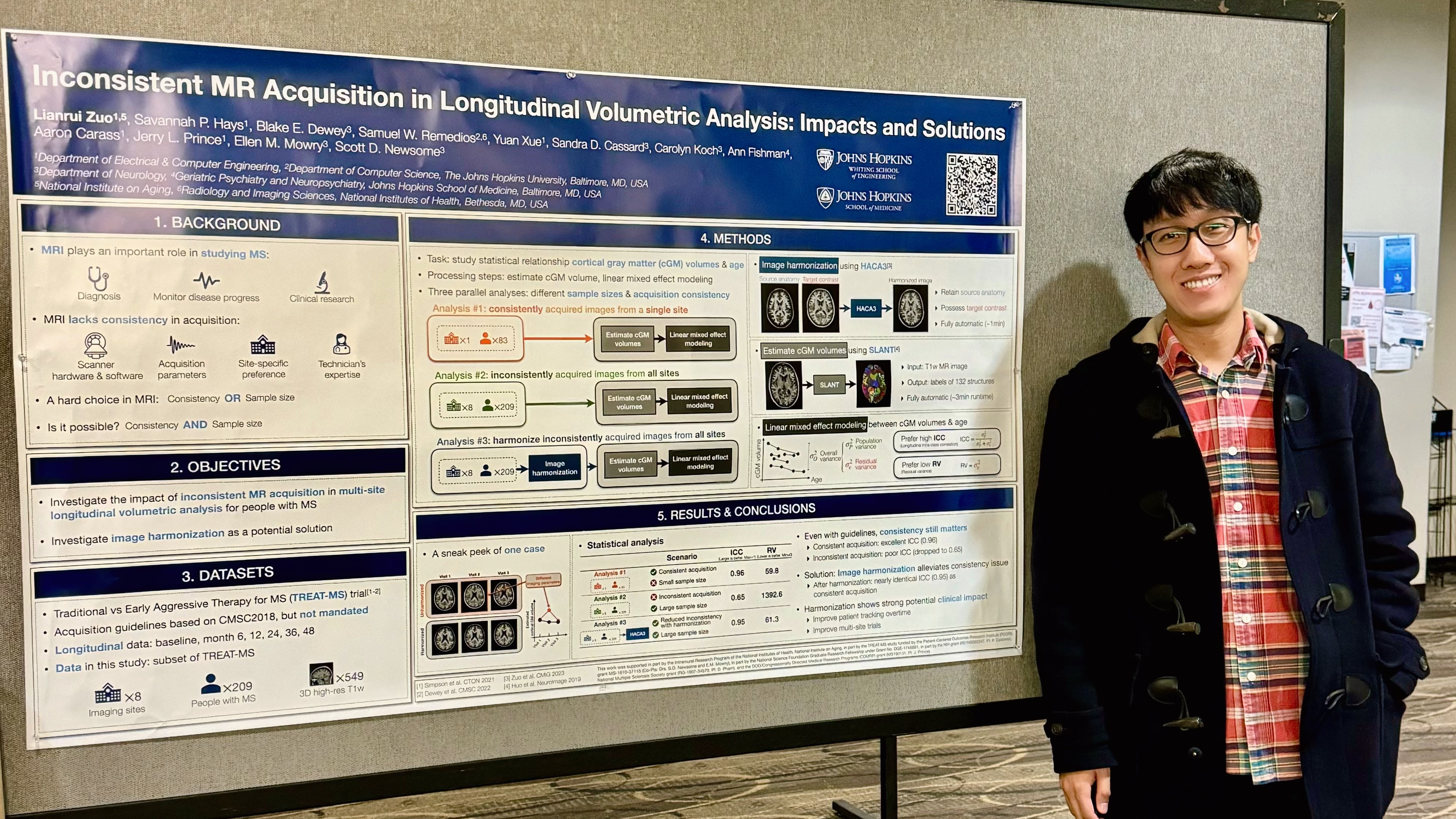
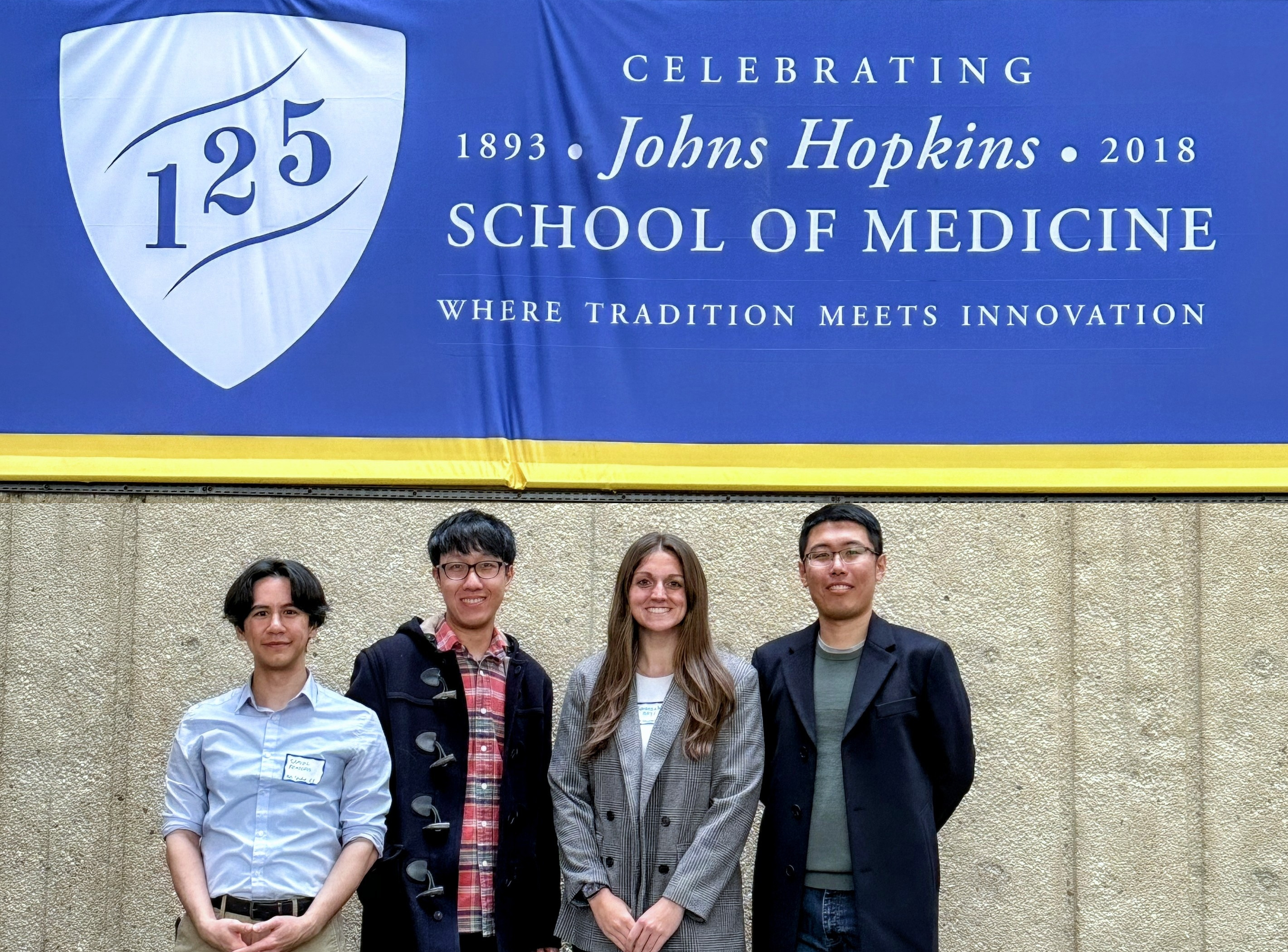
| IACL at the Johns Hopkins School of Medicine and Whiting School of Engineering Research Retreat 2024 | ||||||
|
| |||||
|
| |||||
January
- Yihao Liu successfully defends his thesis titled "Methods for Automated Analysis of OCT and OCTA Images".
- Lianrui Zuo successfully defends his thesis titled "Unsupervised structural MRI harmonization by learning disentangled representations".